
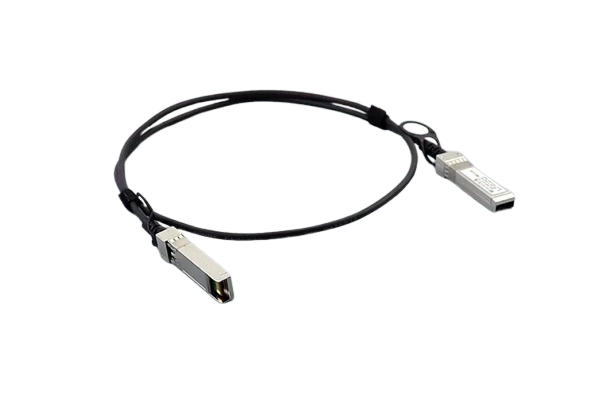
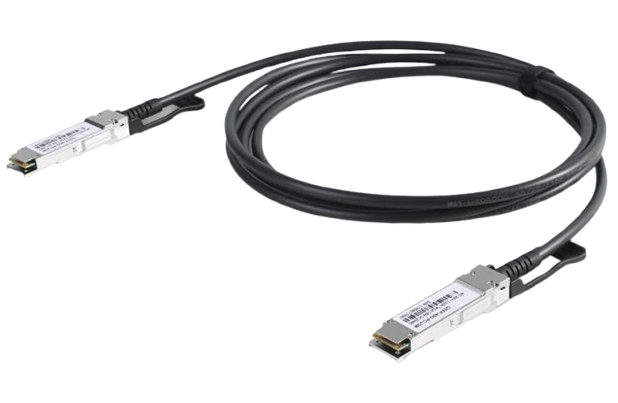
DAC Cable
KEY HIGHLIGHTS
A DAC cable, which stands for “Direct Attach Copper” cable, is a high-speed, pre-terminated twinax copper cable with fixed transceiver modules on both ends, designed to directly connect network devices like servers, switches, and storage within a rack over short distances, typically up to 10 meters, without the need for separate optical transceivers; essentially acting as a “direct connect” between devices due to its factory-terminated connectors like SFP+ or QSFP+ on each end.
A DAC (Direct Attach Copper) cable features a fixed length of twinax copper cable with pre-terminated transceivers on both ends, designed for short-distance, high-speed data connections within a network, typically used in data centers; key specifications include: low latency, high bandwidth, compatibility with various data rates (like 10G, 40G, 100G), limited cable length (usually up to 15 meters), various connector types (like SFP+, QSFP+), and a copper construction with different AWG gauges depending on the desired data rate; DAC cables can be passive (no signal amplification) or active (with electronic components for longer distances) depending on the application.
Key features:
- Short distance connectivity:
Primarily used for short connections within a rack or between adjacent racks due to signal attenuation over longer distances.
- High bandwidth:
Capable of supporting high data rates like 10Gbps, 40Gbps, and 100Gbps depending on the cable type and connector.
- Low latency:
Provides minimal data delay due to the short copper cable length.
- Cost-effective:
Generally cheaper than fiber optic cables for short-distance connections.
- Easy installation:
Plug-and-play design with pre-terminated connectors.
- Compact size:
Smaller and more flexible than fiber optic cables.
- Connector types:
SFP+, SFP28, QSFP+, QSFP28 (depending on data rate and application)
- AWG gauge:
Typically 24AWG, 28AWG, or 30AWG, with lower AWG indicating thicker cable for higher data rates
- Jacket material:
PVC (Polyvinyl chloride)
- Operating temperature range:
0°C to 70°C
-
Cable length: Varies depending on data rate, usually ranging from 0.5m to 15m
- Passive vs Active:
Passive DACs are simpler and cheaper but have shorter reach, while active DACs can reach longer distances with the help of electronic amplification
- Function: Primarily used for high-bandwidth data transmission between devices situated close together within a data center rack, offering a cost-effective solution for short-range connections.
- Construction: Composed of a twinax copper cable with pre-attached transceiver modules on both ends, which cannot be separated.
- Connector types: Common connector types include SFP+, SFP28, QSFP+, depending on the data rate required.
- Passive vs Active:
-
- Passive DAC:
A basic DAC with no signal amplification, suitable for very short distances and lower data rates.
- Active DAC:
Contains electronics to boost signal strength, allowing for longer reach at higher data rates, but at a higher cost.
- Passive DAC:
Advantages:
- Cost-effective:
Generally cheaper than using separate optical transceivers due to the simplified design.
- Easy installation:
Plug-and-play connectivity with no need for additional fiber optic components.
- Low power consumption:
Compared to optical transceivers, DACs typically use less power.
- No heat produced
- High reliability
- Can be used to connect large amounts of bandwidth
DAC cable limitations
- Transmission modules cannot be removed from the cable, so all DAC cables are a fixed length
- A Direct attach cable (DAC) is a type of copper cable that connects data center equipment like servers, switches, and storage devices. DAC cables are cost-effective, efficient, and easy to install.
How DAC cables work
-
DAC cables are factory terminated with pluggable transceivers on each end.
-
DAC cables can be passive or active. Passive DAC cables don’t condition signals, while active DAC cables have electronics to boost signals.
-
DAC cables are available in different lengths, usually up to 15 meters.
-
DAC cables are used to connect equipment in racks.
Let’s build the future of connectivity together. Contact us today for custom solutions tailored to your business.